Friday, 1 July 2011

When is an author not an author?


On Authors and Societies.
Like Mr. Acland (author of Friday’s article, ‘When is a writer not a writer?’) I have found myself not rejected but ignored the Society of Authors and, last week, the Author Magazine, and am aware of the automatic omission of 'self-published' authors from admission to literary competitions (for what seem to be obvious reasons).
Having set up my own micro-publishing company, Raven’s Quill Ltd., (taking inspiration from the micro-breweries of California) to publish my own fiction, children's and adult, I published my first book at the end of Oct. 2008 and my second at the of end Oct. 2010.
Here's what I've managed so far:
• My first book has sold 7,000 in hardback at £15 and second 1,300 at £10.
• Both books are in Gardner’s and Bertram’s wholesalers.
• Raven's Quill is a member of both the PA and IPG.
• Company is in receipt of UKTI grants to exhibit at international books fairs and have done so at the LBF, Frankfurt and Bologna.
• Translation rights sold to S. Korea and Israel for first book.
• Big Apple, Amo, and Ilustrata agencies represent in their language zones.
• I am lucky to enjoy a great relationship with the Waterstone's chain (Central children's buyer: "Those are really phenomenal sales") at which I promote my own books quite effectively at signings, averaging 30+ on weekdays and 40+ on Saturdays (It took 2 days to sign up 31 branches from Exeter to Ipswich for my summer tour).
• Both books, as e-books, are now on Amazon Kindle's 'Summer Reads' promotion as of today (Friday) till 31st Aug. (each priced at £1.49)
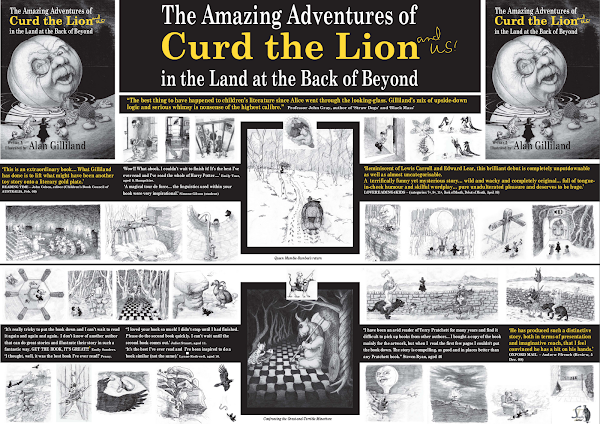
• 'Curd the Lion' was made a Book of Year for the Lovereading4kids website, at the end 2009 (review, see below)
• 'The Flight of Birds' featured on its sister website, Lovereading, placed at the top of 'Fantasy, Horror and Sci Fi' in Dec. 2010.
• Curd was reviewed by The Northern Echo, The Yorkshire Post, The Oxford Mail and by Reading Time (journal of Children's Book Council of Australia).
• 'Curd' has had two brushes with Hollywood so far and HiT Entertainment wrote of it: "We really enjoyed the inventive witty narrative and surreal humour in the book. We can see that Curd the Lion might work very well as a family feature film." Tfou (TF1 France) wrote similar assessment.
• Children’s author Katherine Langrish wrote: "I agree this is a really unusual book - with brilliant illustrations, too. Think Edward Lear, Lewis Carroll, lots of wordplay and paradoxical fun, and you'll be there. Not for every child, perhaps, but any budding chess players or crossword puzzle fiends will have a whale of a time. It demands something of the reader, and that's not a bad thing at all."
• BookWitch Blog wrote nice review of 'Curd" in March: http://bookwitch.wordpress.com/2011/03/15/curd-the-lion-and-friends/
• Lovereading4 kids review. "Reminiscent of the writing of Lewis Carroll and Edward Lear, this brilliant debut children's novel is completely unputdownable as well as being almost uncategorisable. The author has succeeded in delivering on a book that incorporates a terrifically funny yet mysterious story, full of larger-than-life highly improbable characters that I couldn't begin to do justice to by describing them here, other than to say they are wild and wacky and completely original. He's also delivered a story that is full of tongue-in-cheek humour and skilful wordplay. It's 174 pages of pure unadulterated pleasure and deserves to be huge. This book will be loved by anyone from 7 to 107."
• Mike Shatzkin - e-book guru and organizer of last week's 'Publishers' Launch' conference attended by the cream of British publishing - kindly invited me for an hour's conversation at his hotel last week after that conference. Previously he had written: "Alan, what a great story! I'm glad you didn't ask me before you undertook to do this because I would have told you it was nigh on impossible! But, having achieved this much, I think your Korea sale is just the first of many you'll make around the world. You should find a literary agent to sell rights for you in the US, Canada, and Australia right away." [A few weeks before the Israeli offer]
[The activities in which I have been engaged look remarkably like those of a traditional publisher with the exception that one person performs most of them. You can judge for yourselves whether this constitutes any kind of validation of legitimacy as an author.]
Neither of the Society of Authors nor the Author Magazine has responded, even to acknowledge my applications, despite being sent polite reminders. [I am not aware that I have been in any way discourteous to them.]
 I am merely arguing here for more flexible criteria used by the AS in assessment, as more and more authors, whether published previously or not, are turning to self-publishing (mainly as e-books) with a variety of different motives: to keep their back list alive; to gain more control of the forms in which they are published; to prove (or not) the viability of their new work in the real marketplace, in some cases to attract the attention of traditional agents or publishers, in others to see if they can earn more this way than traditionally-published authors.
Authors choosing this route are not in general decrying the value of the services provided by traditional publishers (editing in all its forms, marketing and promotion) except where these are seen to be failing due those publishers’ concentration on certain sections (celebrity) at the expense of others. 
 I am asking that the criteria of acceptance should not merely be based on whether an author is being or has been published by an established publisher but should be widened to take cognizance of actual real world achievement, where this exists, by authors who fall outside this simple categorization.
 To use my own example: I set up a company to publish my work. I have written under two names. Now had I set up the company (as I was originally tempted to do) under a pseudonym or friend’s name (i.e. Son-in-law), that company would have been seen to be publishing two authors each of whom was gaining solid, if not thrilling, sales. Thus those authors could quite validly apply for membership of the Society of Authors and be entered for literary competitions by the startup company under whose aegis they wrote. My guess is they would almost certainly be accepted into that society because their publishing company was seen to be publishing authors (other than themselves). 
 I do wonder at the apparent rigidity and question the validity of the criteria the Society of Authors imposes for acceptance as an author in this time of flux and radical innovation impinging rapidly upon the accepted mores of the publishing world of the last century.

 Books:
'The Amazing Adventures of Curd the Lion (and us!) in the Land at the Back of Beyond' - Alan Gilliland, author / illustrator. 80 illus. 160pp. h/b. £14.99. ISBN 9780955548611 (e-book -42) A nonsense quest story for children.
'The Flight of Birds' - Alan Howard. 400pp. p/b with French flaps. £9.99. ISBN 9780955548628 (e-b. -66) An adult - Y/A gothic ghost tale.
I otherwise illustrate exclusively non-fiction for publishers – including the Penguin Group, Osprey, Windmill (ex-BRG), Ivy, Aurum and others – and architects including John McAslan & Partners. Former graphics editor of the Daily Telegraph (18 years  – 21 national / international awards).

KINDLE SUMMER PROMO - Both books at £1.49 KIndle edition.

Bothof my books are now available on the KINDLE SUMMER PROMO for a limited period at £1.49!

Anyone readsing this blog please pass the word on?

“The Amazoing Adventures of Curd the Lion (and us!) in the Land at the Back of Beyond” e-book ISBN 9780955548642 is here:


http://www.amazon.co.uk/Amazing-Adventures-Curd-Beyond-ebook/dp/B00486U39A/ref=sr_1_1?ie=UTF8&m=A3TVV12T0I6NSM&qid=1309512493&sr=1-1

and “The Flight of Birds” by Alan Howard e-book ISBN 9780955548666 is here:


http://www.amazon.co.uk/The-Flight-of-Birds-ebook/dp/B004AM5BJ4/ref=sr_1_2?s=books&ie=UTF8&qid=1309513008&sr=1-2

Friday, 24 June 2011

JK Rowling, Pottermore and The Daily Telegraph


I thought that today I would share with you the conversation I had with JK Rowling and Pottermore concerning The Daily Telegraph’s* wrong-headed assertion that she was about to undermine the ability of publishers to fund new authors (which is done through advances enabled by the profits they make from established to-level authors such as JK).

OnundTreefoot Alan Gilliland
@jk_rowling @pottermore All pottermore profits going to foundation to support new writing as JK repays support she received in starting out?

OnundTreefoot Alan Gilliland
@jk_rowling @pottermore I am said struggling author in need of pottermore funding. 1st book sold 7,000 hb - nonsense story – Curd the Lion

OnundTreefoot Alan Gilliland
@jk_rowling @pottermore Can you tell me when I can expect 1st advance from generous fund set up to aid new authors?

OnundTreefoot Alan Gilliland
@jk_rowling @pottermore 2nd book gothic ghost tale The Flight of Birds sold 1,300 so far. Urgently need funding to reach next level.

OnundTreefoot Alan Gilliland
@jk_rowling @pottermore Bid in now as know how quickly pot-fund will grow to all-consuming monster denying publs ability to fund new authors

OnundTreefoot Alan Gilliland
@jk_rowling @pottermore We future recipients of your generosity salute you, JK. You can contact me via my blog ‘Pencilnotes’ or send cheque

OnundTreefoot Alan Gilliland
@jk_rowling @pottermore I wanted to add just how wrong The Telegraph article is in saying you are about to undermine future of new writers

As our correspondence shows, JK does not deny the correctness of my assumption that she is setting up Pottermore for the greater good of the community of writers who are struggling for recognition as she once did. We know that JK, far from being, as described by the Telegraph, like Voldemort, has the heart of Harry Potter, the looks of Hermione and the magical ability to transform the lives of aforementioned deserving authors. Will she use it for evil selfish ends as the the Telegraph claims or to save, like Harry, her fellow-writers from the Slush-monster?
Tune in for newsflashes on the burning issue of the day: books.


*http://blogs.telegraph.co.uk/technology/adrianhon/100006726/why-jk-rowlings-pottermore-will-frighten-struggling-authors-%E2%80%93-and-remember-she-used-to-be-one/?

Sunday, 19 June 2011

Father’s Day special.

(In response to the good wishes of my boys of assorted size and girl of a particular nature)
Thank you. Book signings going well.

Met an agent at my book signing yesterday in Woking. “I’m a Literary Agent,” she chirped, smiling at her little boy, “I’m the wrong audience.” [This before looking at either of my books.]
Really, the very idea of talking books with an agent!
[She promptly went off and bought a ‘Man Tin’ for Father’s Day, simultaneously demonstrating her own sophistication and a justification for the implementation of that product diversification in Waterstone’s book stores so beloved by literary types.]
However, I did sell 43 to non-agents who were open to new authors. Previous two Saturdays sold 49 and 47.
£1,765 worth of books of which £750 to me or £250 per day. Not bad, some may feel, for a lowly self-published amateur’s Saturday job?
[Thinks: I wonder how much that agent’s carefully selected but not A-list authors make at signings. Loads more, of course!]

As a special treat for Father’s Day Pauline (my wife) is letting me cook dinner for five: Ben & Charlie (eldest son and spouse) are joining young Jack (youngest son) for a pork & prawn Nam Prik type dish with Thai flat noodles with spiring onions and cucumber, together with an Indian mango curry and Kropoe (prawn crackers). For dessert we are having simply fresh strawberries and lashings of cream.

All is not as it seems: Pauline has a rare and steaming cold and bruised feet after she and Emily (my daughter of not-yet-Vintage-Pixie-fame) organised a very successful vintage clothing and craft fair at Shalford near Guildford yesterday at which Charlie’s Jumbly Crumbly Kitchen was a cakey-sellout. Despite the torrential showers all went well with a large turnout and tasty profits all round, repaying the three days they (P.E.C.) spent trudging the area dropping leaflets through 2,500 doors.

Friday, 17 June 2011

Summer-tour-in-a-tent signings extravaganza!

Started booking my Summer signing tour yesterday (in the absence of my trusty promotions team) and have already signed up 28 venues from Exeter to Ipswich!

After my wife upended my red-pocket-rocket, my perfect Pug, last year…
BEFORE


AFTER


She managed to steer it right between those two trees, down an embankment, overturn it and yet escape with just a bruised thigh and scratched arm! Spectacular, huh? (She crawled out of the back door – the side doors were jammed till two burlies yanked them open)

I now drive our grey metallic 207 turbo – Mr Q!
And pitch my 5-man tent (I’m bigger than I used to be) – alone and unaided

for five weeks – on strategically located hubs from Dorset to East Anglia, and sign in stores in towns radially reachable, returning home for the odd weekend – and that’s my summer holidays folks.
While all of you’s are sunning yourselves like beached whales on tropic sands or mediterranean shores
I work my little butt off.!


Wednesday, 15 June 2011

A dreary whimsy in green…


Croaking loudly in the oxbow lakes in which they swim as the meandering river of the great plain sluggishly breaks free and starts to run by them, literary agents in their arrogance remind one of nothing more than this description in Emily Dickinson’s lines:
“How dreary to be somebody!
How public, like a frog
To tell your name the livelong day
To an admiring bog!”

In their own words, their opinions are “Riveting, riveting…”

The above a random thought sparked by this…
Dreary (David Miller) Agent’s response to Susan Hill “And prizes aren't about fairness. Anyway, hope you're having fun wading through the rest of the poo published this year.”

And of course, as an outsider, I admit in saying this to, maybe, you who are listening:
“I'm nobody! Who are you?
Are you nobody, too?
Then there's a pair of us — don't tell!
They'd banish us, you know.”

(As they would, if ever they found us out)

Remaining with the frog theme, does not a “knot” of agents seem particularly apposite?

And some say that to rub up frogs the wrong way is to risk the deadly poisons oozing from their pores. But then, we live in Britain, not some fetid jungle, where living trees are pulped for profit?


Letter to Peter Cox regarding agent ethics and other matters


(Peter’s article, see below.)
Hello Peter,
I have just read with some fascination your argument regarding the ethics of the agent’s role. I can’t remember how I found it but my trail started with the Nosy Crow defence of the Sainsbury’s award.
As an outsider with neither an agent nor a publisher who has sold, mostly undiscounted, around 7,000 copies of my first, illustrated nonsense children’s, in hardback at £14.99and 1,200 of my second, adult gothic ghost tale, in paperback at £9.99, traditionally printed, I am merely an observer of the tribulations and machinations of both sides of the “added value” chain.

In her defence of Sainsbury’s I was a little shocked at the extremely modest figures, both in sales and revenue-to-author, of the examples she quoted: 3,000 copies sold through Sainsbury’s equating to 2,000 through an independent bookshop to realise £900 for her client (the creator as author or illustrator). I was not shocked at the percentage but at the low expectation of sales figures.
Is it really the case that a publisher, with connective, logistical and marketing power at their disposal, has such low expectations of sales volume while accepting such drastic discounting? (It may be that this was an abstract random example merely to show the relative sales between outlets but her introduction of the ALCS’s median author income figures leads me to believe otherwise. I realize the publisher benefits through the accumulated title income but this little helps the individual author. [Which relates to your issues with agents becoming publishers I guess])
Ok, she is one publisher, and a new one, but her ability to self-promote is peerless (she is everywhere to be found plugging NC or pontificating on publishing futures), so it is doubly disheartening to see that she, apparently, has such low volume expectations (I also read a sub-text into her article aimed squarely at her authors and illustrators), and I wonder if this translates to the major publishers for the majority of their new titles (we keep hearing about the onus incumbent on non-A-list authors to ‘get out there and promote your own work’)?
You, as an agent, should be in a position to answer this question and I hope you will be kind enough to do so.

How does this relate at all to your article? Indirectly, inasmuch as your discussion of agent integrity conflicting with the trend to agent-publishing leads me to the other half of my concern: the agent half of the value-added question.
Again, as an outsider I watch the publicised mega-deals which give no indication as to the median agent-struck deals with publishers. In the case of a non-mega deal what does the agent bring to the party? How does he/she justify his/her existence in a world where deals are struck with no advances to help the author live while penning his next book and where publishers do increasingly less to push the book, once published?
In such a situation and disregarding e-books for a moment, I would see a distinct opportunity for a new type of publishing concern – a developmental/copy-editing, proofreading and pre-production company working with authors to facilitate the production of their own work under the aegis of their own companies under one of the following agreements:
  1. Prod Co contracted at straight flat-rate payment for work done for Author Co that pays the printing, shipment, and storage etc., costs. Author Co benefits by lowered print rates through Prod Co’s total printing volume.
  2. For new or cash-strapped authors, Prod Co, after initial editorial viability vetting, enters an arrangement balanced between direct payment and royalties (i.e. in reverse of the current norm, with the possibility that some of these will achieve high volumes and continued income for the Prod Co)
Here the Author Co takes the 42.5-60% share of list price through wholesalers or bookshops direct for street sales or the equivalent through e-tailers.
Basically this is what I have been doing these past two years, paying for runs between 1,000 and 3,000, taking advantage of the print deals* through volume my production company provides (they merely check my pdfs for anomalies and negotiate prices), warehousing and distributing through wholesalers (no Amazon Advantage here – more from Amazon sold through Gardners).
[*Well, I thought they were providing such an advantage! After a falling out I was forced to find my own print deals and found an ace Chinese company, with a London office and an extremely nice and efficient representative here, that printed my Curd the Lion hardback book, retailing at £14.99 on a run of 2,000 at £1.75 including delivery to a UK warehouse – the cheapest by far I’ve had – and perfect quality. DIY strikes again!] 
Ok, I have to pay for printing up front, but I have geared it so that the profit from each pays for the next. Since Gardners take my books in batches between 200 and a thousand my warehousing costs are greatly reduced (and I have found a very cheap warehouse for the remainder).
I originally took the stance, having heard of the self-promotion being demanded of mid-list authors, that I would rather self-promote for 42% than 8% of each sale made. With that in mind I have established a great working relationship with the Waterstone’s chain at which I do signings every Saturday, through half-terms and holidays, just chatting to customers who have never heard of me and talking them into my stories with very consistent results. (Most Saturdays now over 40 books between the two and over 30 weekdays).
I work otherwise illustrating for a range of publishers adult non-fiction titles (Penguin Group, Osprey, Windmill, Hachette Partworks, Aurum, Ivy) plus occasionally for architects (John McAslan & Partners and others) and writing whenever I get free time.
I guess my activities parallel those of a lot of authors represented by agents and published by major companies with the exception that I reap a far greater reward per unit, even after printing, warehousing and distribution costs. (In my position the Gardners business model is so much more viable than the Bertrams where the latter overtly pay when they order, rather than when they sell, but in reality their 90 -120 day payment cycle coincides with an automated returns cycle so that one can be paid just prior to returns being notified and further orders placed for the same books coincidentally.)
It is obvious that everyone concedes that e-publishing is easy (with the caveats of the observed shortfall in proofreading/copyediting for each format in which the e-book is distributed) and in ignorance of that caveat, cheap. Apps are a different matter.
Agents, like authors, it seems, are tempted by the apparent lack of infrastructure needs to set themselves up as e-publishers.
In my case, to avoid the fraught contractual niceties, I have signed up to work under the aegis of Faber Factory (iBookstore deal announced today) – they chunder through the contractual mires while I pay a percentage for the privilege of collecting a cheque each month. Neither has worked out an effective pricing or marketing strategy though their (and others’) success in tactically lowering to 99c. leading to exponentially increasing sales to a plateau, followed by a slow decline, largely upholding sales after returning to the original or a price somewhere between, has worked very well.
But this is merely a short-term big deal for the early adopters, and already it is being said that reduction per se will not be enough, but that every book will have to find a ‘gimmick’ to raise its profile above the horizon, or by exploiting or creating interest-group communication and loyalty (‘verticality’ in Shatzkin’s jargon).
Here publishers are disadvantaged in that the main retailer, Amazon, and Apple, to a lesser but growing degree, know every purchase and the addresses etc., of every customer and can extrapolate from these their interests and tastes to a degree unheard of before. Publishers are left out in the cold and must find ways to generate their own feedback loop to and from their customers as some are trying.
The FT’s adoption of a pseudo-app (Majoobi – see Tech Digest for details) for all devices announced yesterday is a major step in this direction, if not quashed by Apple, in that they have what appears as an app downloadable but not subject to the App store conditions and vetting procedures. It gives them direct purchasing and access to what is read by whom, with all the information that carries
Whether this leads to the Android-style chaos that is a direct result of unvetted apps allowing malware onto their devices, has yet to be seen. If so, Apple will assuredly find a way of banning such pseudo apps. [Otherwise pretty damned exciting especially for small guys like me because cheap and cheerful but looking good.]
It is very difficult to see how publishers can catch up with direct sales or persuade the major e-tailers to divulge their customer preference databases since the latter would facilitate the former undermining their own information-advantage and market dominance.

Wow! I didn’t mean to get this carried away, but it all leads back to my basic question: what advantage, in the emerging ecosystems through which readers are connected to writers (and illustrators) have the massive (statistically-savvy but individually-ignorant) behemoths of the last publishing century over “early-mammalian” micro-publishers?
It seems a particularly fruitless quest for agents to aspire set up as publishers at the same time as the mega-e-tailers (Amazon, Apple, B&N, etc.) are doing precisely the same thing but with direct access to individual consumer taste, purchase frequency, type and price point, indicating wealth level and increasingly revealing social demographic status, permitting irresistible advertising, according to their evolving models, on an individual level.

As an outsider I would be only too pleased to have someone come along and say, “Hey, I’ll take all this load off your shoulders to let you get on with the task of creating,” but all I see from this side of the fence is seeming confusion and uncertainty fuelling panic and withdrawal of that real support, cultivating authors through time, that was a hallmark of the great editors and agents.

I would greatly appreciate it, if you have time, if you would give your viewpoint on these issues.
Best wishes,
Alan.

He very kindly and interestingly replied, agreeing with many of my points and giving me some fascinating insights, for which I am grateful.
I post this as a spur to debate, in the vain assumption that someone reads this blog!

Article: Your agent should not be your publisher. Peter Cox.
http://www.redhammer.info/news/agent-publisher/